Buying property is exciting — but doing it in a tough economy? That takes nerve, and it takes good information. Right now, prices at the shops are climbing again, borrowing is expensive, and every headline seems to warn you off big decisions.
Here's the honest truth: the Islamabad real estate market 2026 is a challenging one. But challenging doesn't mean hopeless. Smart buyers still find real value — they just have to know where to look.
This guide gives you the straight picture, backed by official numbers. You'll learn:
- What the economy is actually doing right now
- Why demand for homes stays strong even when times are hard
- Where well-located, legally approved property still holds its value
- How to protect your money before you sign anything
Let's get into it!
Quick answer: What's the Islamabad property outlook for 2026?
Short on time? Here's the summary in plain terms.
The economy is under real pressure. Inflation jumped to 11.1% year-on-year in August 2026, and the State Bank has held its policy rate at a steep 11.5%. Borrowing is costly and prices are rising. Yet demand for property stays strong, propped up by record overseas remittances and a deep housing shortage. In this climate, legally approved property in well-connected areas — think the airport corridor and established Islamabad sectors — offers the safest path to holding value. For careful buyers who verify approvals, 2026 rewards patience and punishes rushed decisions.
Now, the full reasoning behind each point.
The economy right now: an honest look
Think of the wider economy as the weather for your investment. You can't change it, but you'd be foolish to head out without checking the forecast first.
And the forecast? It's stormy. Let's not pretend otherwise.
According to the State Bank of Pakistan's Monetary Policy Statement, headline inflation rose to 11.1% year-on-year in August 2026, up sharply from 9.2% in July. The Pakistan Bureau of Statistics tracks this climb, and it's driven by higher food, energy, and fuel prices. In plain words: your rupee buys less than it did a few months ago.
Borrowing is expensive too. On 14 September 2026, the State Bank kept its policy rate at 11.5%. That keeps home financing costly and slows down buyers who need loans.
There's a flip side worth knowing. SBP's foreign exchange reserves climbed to $21.4 billion, and GDP is projected to grow 3.5% to 4.5% in FY27. So the picture isn't all gloom — there's ground to stand on. But the Committee also flagged rising risks from Middle East tensions and supply chain disruptions.
Here's the takeaway: the market is tough, and prices are under upward pressure. Go in with open eyes, not a rushed heart.
What keeps property demand strong anyway?
Numbers on a screen don't buy homes — people do. So who keeps buying, even when money is tight?
A housing shortage that won't quit
Pakistan has a deep, structural need for homes. The country faces a shortfall of roughly 10 million housing units, and that gap grows every year.
This isn't a passing trend. When far more people need homes than there are homes to go around, well-located property tends to keep its worth — even in hard times. Scarcity does the heavy lifting.
Record money coming from abroad
Overseas Pakistanis are a powerful force here. Remittances hit a record of around USD 38 billion, and a big slice flows straight into property back home.
Why property? Because it feels safe, solid, and familiar. For families sending money from the Gulf, the UK, or North America, a plot or apartment in Islamabad is both an investment and an emotional anchor. Overseas Pakistani investment doesn't vanish when the economy wobbles — often, it grows.
Here's the takeaway: demand rests on two sturdy legs — a real housing shortage and steady overseas money. Neither disappears overnight.
Where does value actually hold in a tough market?
When money is tight, buyers get picky — and that's exactly why location matters more than ever. Weak markets punish poor choices harder than strong ones do.
So where does your attention belong? On property that ticks three boxes:
- Legally approved. A valid approval protects your money when things get shaky.
- Well-connected. Roads, highways, and airport access pull in tenants and buyers.
- Backed by real infrastructure. Working utilities beat empty promises every time.
Broadly, the safest picks in the twin cities share those traits:
- Established CDA sectors for stability and reliable resale.
- The airport corridor belt for genuine growth potential.
- Approved high-rise projects for lower entry cost and quicker rental income.
Each option suits a different goal. Our guide to the best areas for property investment in Islamabad compares them in detail. And if you're torn between land and a built unit, our high-rise vs plot investment article lays the trade-offs out clearly.
Here's the takeaway: in a hard market, quality and legality beat cheap and risky. Every time.
Why the airport corridor still stands out
Some areas grow on hype. Others grow on roads, airports, and real access. The airport corridor sits firmly in that second group — and that's exactly why it holds up when the wider market struggles.
Airport corridor property sits close to Islamabad International Airport, Kashmir Highway, and the M1/M2 Interchange. That connectivity draws tenants, buyers, and businesses — the very mix that supports demand through good times and bad.
For overseas buyers, the appeal is practical and lovely. You can land, check on your property, and be back at the terminal in minutes! That convenience isn't just comfort — it feeds steady, real demand.
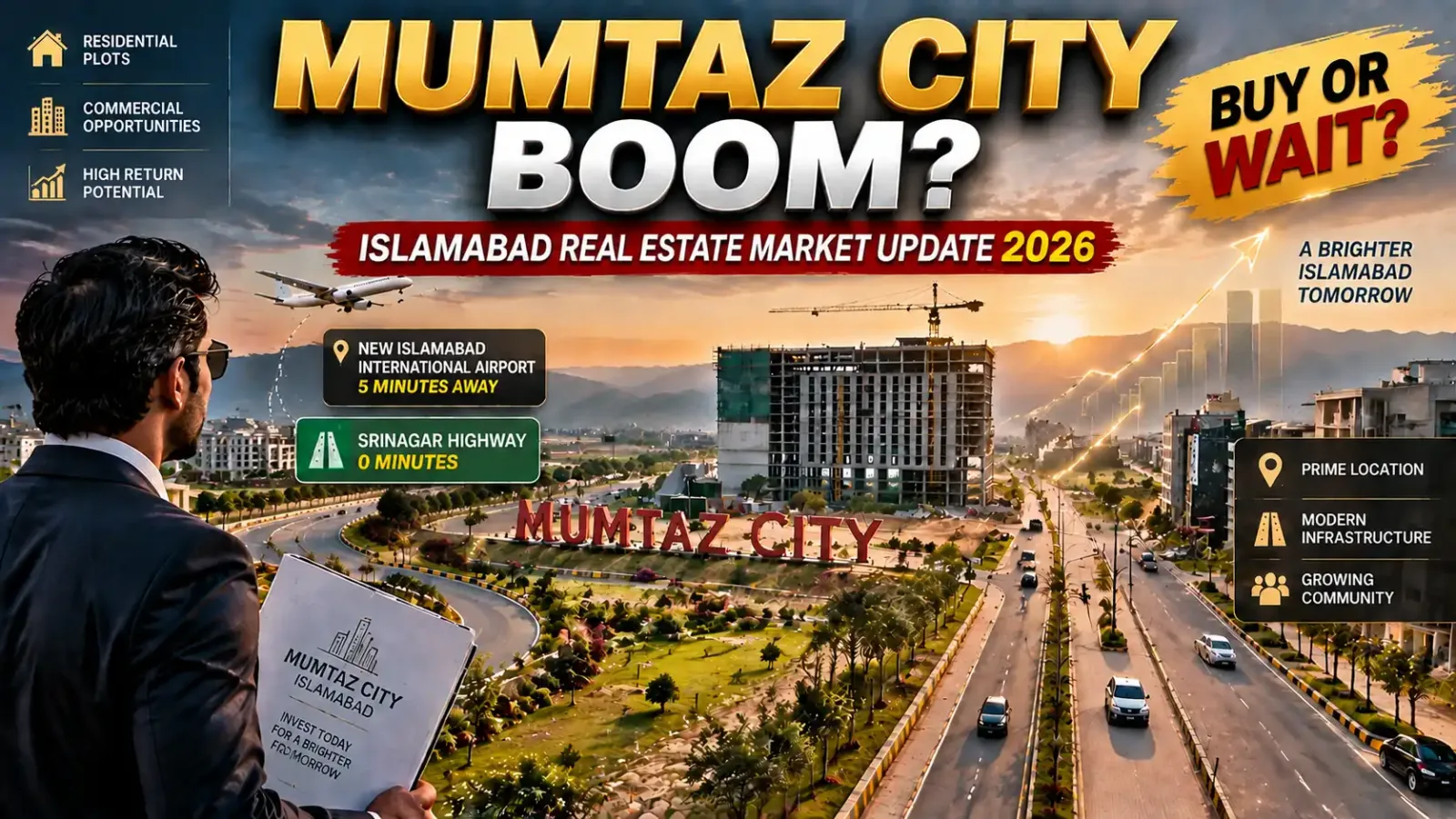
Mumtaz City is a standout along this belt. Our guide on why to invest in Mumtaz City in 2026 explains how location and legal approval combine there to protect value.
Here's the takeaway: access drives demand, and the airport corridor has access in spades.
The legal side: approvals you can't skip
Here's the honest truth about property in Pakistan. In a tough economy, the biggest risk isn't a slow market — it's buying into something with no legal standing at all.
Every year, buyers lose their savings to schemes that were never approved. Hard times make desperate buyers, and desperate buyers skip checks. Don't be one of them.
Two authorities matter most around the capital:
- The Capital Development Authority (CDA) governs Islamabad's zones and publishes housing scheme records.
- The Rawalpindi Development Authority (RDA) covers Rawalpindi-side developments and lists approved societies.
Before you pay a single rupee, confirm the specific project's No Objection Certificate (NOC). Don't settle for a vague "the area is approved" claim — ask for proof tied to your exact unit or plot.
For larger buys, check the developer's legal standing through the Securities and Exchange Commission of Pakistan (SECP). And factor in taxes early — the Federal Board of Revenue (FBR) updates its property valuation tables regularly, which affects your total cost.
For a full walkthrough, read our guide on real estate property verification in Islamabad. It shows you which documents to check and which red flags to walk away from.
Here's the takeaway: RDA approved projects and verified CDA schemes turn a risky purchase into a protected one.
What rental yield can you realistically expect?
Money that sits still doesn't grow — money that earns does. In a costly economy, that matters more than ever, because rental income helps offset your holding costs.
A useful benchmark is around 6% annual net yield. The formula is simple:
Annual net rent ÷ purchase price × 100
So a unit earning PKR 12 lakh in net rent on a PKR 2 crore price gives you a 6% yield. Anything well below that may signal an overpriced property or optimistic rent estimates.
Well-connected apartments — especially near the airport corridor — tend to attract steady tenants. That reliability is gold when the broader market feels shaky. Always ask for real rental figures before you commit, then compare across a few options.
Here's the takeaway: use the 6% benchmark as your quick sanity check on any deal.
Your 2026 buyer checklist
Before you commit, run through this short list. It takes a few minutes and can save you a great deal of stress later.
- Confirm the NOC against the official CDA or RDA records yourself.
- Verify the developer through SECP for larger purchases.
- Check current taxes on the FBR portal before you budget.
- Compare rental yield using the annual-net-rent-over-price formula.
- Read the full payment plan and hunt for hidden charges.
- Decide your goal — income now or long-term value — and match the property to it.
- Work with a trusted advisor who welcomes your questions instead of dodging them.
That last point matters as much as the property itself. Our guide to picking a trusted sales partner for property investment in Islamabad shows you exactly what to look for.
Common mistakes to avoid in a tough market
Hard economies make certain errors more tempting. Watch for these:
- Chasing the lowest price. Unusually cheap plots often lack approval — that's why they're cheap.
- Skipping the NOC check. A polished brochure is not proof of anything.
- Ignoring location. A cheap plot nobody wants to rent isn't a bargain at all.
- Rushing under pressure. Genuine deals don't vanish in 24 hours, no matter what a seller says.
Frequently asked questions
Is 2026 a good time to buy property in Islamabad?
It depends on your choices. The economy is tough — inflation hit 11.1% in August 2026 and the policy rate sits at 11.5%. But demand stays strong thanks to a housing shortage and record remittances. Well-located, legally approved property still holds value. Rushed or unapproved buys carry real risk.
Is inflation in Pakistan rising or falling in 2026?
Rising. Headline inflation climbed to 11.1% year-on-year in August 2026, up from 9.2% in July, according to the State Bank and Pakistan Bureau of Statistics. Higher food, energy, and fuel costs are the main drivers.
Will high interest rates affect property prices?
Yes. With the policy rate at 11.5%, home financing stays expensive, which slows loan-dependent buyers. That can cool demand in some segments. But approved, well-connected property tends to hold value better than distant, unapproved land.
Which areas in Islamabad hold value best in a tough market?
Approved CDA sectors and the airport corridor belt look strongest. Both offer genuine connectivity and legal standing, which support long-term value far more reliably than cheap, unapproved schemes.
Is it safe to invest in Islamabad property from abroad?
Yes, with care. Confirm approvals through official portals, work with an authorized sales partner, request a live video walkthrough, and pay in verified stages rather than wiring the full amount up front.
How do CDA and RDA approvals protect my money?
A valid NOC from the CDA or RDA means your property rests on legally recognized ground. Without approval, you have little protection if a deal goes wrong — a risk that bites hardest in tough times.
What rental yield should I expect in Islamabad for 2026?
A useful benchmark is around 6% net yield. Divide your annual net rent by the purchase price and multiply by 100. Compare that figure across properties before you decide.
Making the right call for 2026
Here's the core takeaway, plainly stated. The Islamabad real estate market 2026 is a difficult one — inflation is climbing, borrowing is costly, and risks are real. Pretending otherwise helps nobody.
But difficult isn't the same as closed. Demand still runs deep, powered by a genuine housing shortage and record overseas investment. And in a tough market, legally approved, well-connected property — especially along the airport corridor — is where value holds firmest.
None of that replaces your own homework, though. Confirm every approval, compare the numbers honestly, and choose location over hype. This is guidance, not financial advice — your decision should fit your own budget and goals.
Ready for a clear-headed second opinion before you commit? Reach out to M Realtors for a free, no-obligation consultation. A few careful minutes now can save you months of second-guessing later!